Whats the Point in Buring Calories if You Just Eat Them Again
Key Takeaways
- Eating back the calories you lot burn during do is unnecessary and commonly merely slows weight loss.
- Most of the methods people use to calculate how many calories they burn during exercise overestimate their actual calorie burn, which can lead people to eat more they should.
- Keep reading to larn why "eating back" the calories you lot burn down from exercise is unnecessary and even counterproductive, and what you should do instead.
If yous want to lose weight, i of the most helpful things you can do is kickoff tracking your calorie intake.
This improves your sensation of how much you're eating, where yous can cut back, and how to budget your calories so as to eat your favorite foods while still losing weight.
Many people take this a pace further and commencement tracking their calorie expenditure ("fire") using an activity tracker similar a FitBit, Apple Scout, or Jawbone.
If y'all've used 1 of these trackers, though, you've probably noticed that on some days you burn a lot more than calories than others. A hike, bike ride, or jog tin jack upwardly your calorie expenditure past several hundred calories, and when you plug this information into an app like MyFitnessPal, yous'll meet something like this:
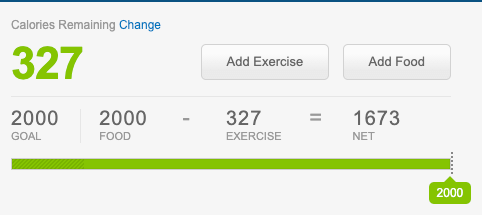
In this instance, the person set a daily calorie budget of 2,000 calories, and they'd already eaten and tracked all of those calories. Merely they also went on a bicycle ride that burned 327 calories, which opens the question . . . should you "eat dorsum" those ~300 calories?
Even if yous don't employ an activity tracker, you've probably wondered the same thing: if you burn more calories on a particular day, should you lot consume more to recoup?
The brusk answer is that no, you probably shouldn't consume dorsum the calories burned during practise.
If you want to know why this is the case and learn a amend way to manage your calorie intake that doesn't depend on action trackers or constantly balancing your daily calorie upkeep in this way, keep reading.
- Why You Shouldn't Eat Back the Calories You Burn Exercising
- What Y'all Should Practice Instead of Counting Calories Everyday
- The Bottom Line on Eating Back Exercise Calories
Table of Contents
Why You Shouldn't Eat Back the Calories You Burn Exercising

The commencement trouble with eating back the calories you lot fire during practise is elementary: if your goal is to lose weight , this is shrinking your calorie deficit, slowing your charge per unit of weight loss.
Now, you lot may have heard that if you don't swallow back the calories y'all burn from exercise that you'll put yourself in an excessively big calorie deficit. For example, if your normal diet puts you in a 500 calorie arrears, and y'all burn 250 more than calories through exercise, that'due south a 50% increase in your deficit (and rate of weight loss).
(Oh, and if you lot feel dislocated near how many calories, how much of each macronutrient, and which foods you lot should eat to attain your weight-loss goals, take the Legion Diet Quiz to larn exactly what diet is right for y'all.)
While that'southward a big relative increase in calorie fire compared to your normal deficit, it's still a small absolute increase. That is, burning a few hundred more calories on 1 day isn't going to cause whatever negative effects on your metabolism or health, and yous may not even experience whatever hungrier than usual.
Basically, unless you're already on the razor'southward edge of low-calorie dieting, burning a few hundred more calories isn't going to cause any problems.
Read: "Metabolic Impairment" and "Starvation Mode," Debunked by Scientific discipline
The 2nd problem with eating back the calories you burn during exercise is that if you lot set your calorie target properly (as explained in a moment), yous should have already factored in the calories you burn down from practise. That is, you're already getting "credit" for the calories you fire working out, and so in that location's no need to increase your calorie intake to compensate.
Want a gratis custom meal planning tool?
Quickly calculate your calories, macros, and fifty-fifty micros for losing fatty and edifice musculus.
Looks similar you're already subscribed!
Finally, nigh people don't know how to accurately gauge how many calories they burn during exercise. And when they overestimate this number, they eat more than than they should.
The popularity of fitness trackers is partly to arraign for this.
Although these tools give people the illusion of pinpoint accuracy, the reality is they only give you a rough estimate of how many calories you're burning through formal exercise and other activities.
What's more, most fitness trackers tend to work all-time at estimating the average number of calories you burn down during a detail action, like walking , only aren't good for measuring much else.
Many of these devices are off by 50% or more (a fitness tracker might say you burned 300 calories during your walk, when you but burned 200 calories). Research also shows that most smartphone fettle tracking apps aren't any better, and are often off past 30 to 50%.
Practise machines that purport to measure your calorie burn tend to be the least accurate of whatever method. For instance, a report conducted past researchers at the University of California-San Francisco'southward Human Functioning center found that, on boilerplate . . .
- Stationary bicycles overestimated by vii%.
- Stair-climbers overestimated by 12%.
- Treadmills overestimated past thirteen%.
- Elliptical machines overestimated by 42% (ooph).
Fitness trackers that utilise your center rate to estimate your calorie burn down tend to be more than authentic than the others we've discussed, but the most accurate ones require y'all to vesture an unwieldy strap around your chest (the wrist-based heart rate monitors tend to be less authentic).
The almost accurate and practical method for computing how many calories you burn during exercise is to utilise what's called the Metabolic Equivalent of Task (MET) system. Although this system works well, it's still non 100% accurate and is irksome to utilize on a daily footing.
You can learn more about the MET system and other methods for tracking your calorie intake in this article:
Read: How Many Calories Do You Really Burn Every Twenty-four hours?
For all of these reasons, information technology'due south non usually a skilful thought to try to "swallow dorsum" the calories you fire during exercise. If you lot want to lose weight, you're only slowing your progress. If you compute your calorie needs correctly, it's unnecessary. And even if there was value in eating back the calories you burn during practise, y'all're likely to overestimate the number and overeat as a result.
Summary: Eating dorsum the calories you burn down during exercise is unnecessary and counterproductive because information technology just slows weight loss and is hard to do accurately.
What Y'all Should Do Instead of Counting Calories Everyday

And so if yous shouldn't swallow back the calories from exercise, what should you exercise instead?
Well, function of the problem with this idea is that it assumes yous should advisedly micromanage your calorie intake and output on a daily basis. Yous burn a chip more and eat a chip more on Wednesday, you lot burn a bit less and eat a bit less on Thursday, and then on.
While this arroyo can work, it'southward also ho-hum, time-consuming, and decumbent to fault.
You lot inevitably waste material time debating over what to eat, working out how much you can eat based on your activity levels, and you make mistakes, like forgetting to log every calorie, mistakenly logging more than or less than you actually ate, or, every bit you learned above, overestimating how many calories you burned from exercise.
Read: How Many Calories You Should Consume (with a Calculator)
All of this is why I don't recommend tracking calories "on the wing" in this way. Information technology'due south simply not a viable long-term solution.
A better arroyo, and the ane used by pretty much every bodybuilding jitney, researcher, and athlete I know, is to judge roughly how many calories you burn every mean solar day on average from all sources (including exercise). This number is known as your full daily free energy expenditure (TDEE).
With this number in hand, you then set a calorie target that's slightly less than this if you want to lose weight; more if you desire to gain weight, and roughly equivalent if you want to maintain your weight.
And once you lot take your calorie target, y'all tin create a proper repast plan that ensures you can hit your calorie and macro targets eating the foods you like. Then, losing weight becomes a uncomplicated process of sticking to your meal plan every day and adjusting your average calorie intake every bit needed based on how your trunk responds.
This organisation even works well if your free energy expenditure fluctuates quite a bit from solar day to day. For example, if you enjoy vigorous cardio workouts , you might fire 1,000 or more calories from exercise several days per week, and simply burn down a few hundred on other days.
Then long as you lot accurately calculate your TDEE, though, you don't necessarily need to eat more on the days yous work out and less on the days you don't—y'all tin just eat roughly the same corporeality every solar day with equally good results. (That said, there's nothing incorrect with cycling your calorie intake based on your activity levels if you want to go to the trouble—information technology'due south just not necessary).
If you want to larn more about how to accurately judge your TDEE and create effective fat loss repast plans, check out this article:
Read: The Definitive Guide to Constructive Meal Planning
And if you lot don't feel comfortable creating a meal plan of your own, we'd love to help yous.
If y'all're pretty flexible about what kinds of foods y'all like to eat, you want to check out our cut repast plan templates for men and women . When you buy i of these plans, you get 10 pre-fabricated meal plans with grocery lists, and then you never go bored with your diet.
Click the links below to larn more:
⇨ Men'due south Cut Meal Plans
⇨ Women'southward Cutting Meal Plans
If you have more specific dietary needs or wants, you want to check out our 100% custom meal plan service . When you purchase this program, you make full out a questionnaire with your fitness goals, food preferences, and everything else needed to create your programme. Then, 1 of Legion'due south diet coaches uses this data to build a custom meal program that perfectly suits your goals, preferences, and lifestyle.
Summary: Instead of tracking your calorie intake and expenditure every twenty-four hours, a better arroyo is to estimate your boilerplate daily calorie burn, and then create a meal programme based on this number to lose, gain, or maintain your weight.
The Bottom Line on Eating Back Do Calories
Once you larn the calculus of energy residuum and how to track your calorie intake and expenditure, information technology'south logical to assume you should suit how much you consume based on how much y'all burn each and every day.
That is, at first glance, it makes sense to "eat back" the calories yous burn from practice.
In reality, though, this is a slow, time-consuming process that often just slows weight loss.
What's more than, if you lot calculate your calorie target properly ( as explained in this commodity ), the calories burned during exercise are already broiled into your daily calorie goal.
Instead of tracking your calorie intake and expenditure every day, a better approach is to estimate your average daily calorie burn, so create a meal plan based on this number to lose, gain, or maintain your weight.
Do that, and you'll be able to command your body composition without the headache of counting calories every day.
What's your take on eating dorsum exercise calories? Accept anything else to share? Allow me know in the comments beneath!
+ Scientific References
- Keytel, 50. R., Goedecke, J. H., Noakes, T. D., Hiiloskorpi, H., Laukkanen, R., van der Merwe, L., & Lambert, E. 5. (2005). Prediction of energy expenditure from heart rate monitoring during submaximal exercise. Journal of Sports Sciences, 23(3), 289–297. https://doi.org/x.1080/02640410470001730089
- UCSF. (n.d.). UCSF Human Performance Center featured on Adept Morning America | UC San Francisco. Retrieved November 9, 2020, from https://www.ucsf.edu/news/2010/02/3569/ucsf-human-performance-middle-featured-good-morning-america
- Konharn, One thousand., Eungpinichpong, Westward., Promdee, M., Sangpara, P., Nongharnpitak, Southward., Malila, W., & Karawa, J. (2016). Validity and reliability of smartphone applications for the assessment of walking and running in normal-weight and overweight/obese young adults. Journal of Physical Activity and Health, 13(12), 1333–1340. https://doi.org/10.1123/jpah.2015-0544
- Cruz, J., Brooks, D., & Marques, A. (2017). Accuracy of piezoelectric pedometer and accelerometer step counts. Journal of Sports Medicine and Physical Fettle, 57(four), 426–433. https://doi.org/10.23736/S0022-4707.16.06177-Ten
- Wallen, M. P., Gomersall, S. R., Keating, S. Due east., Wisløff, U., & Coombes, J. Southward. (2016). Accurateness of heart rate watches: Implications for weight direction. PLoS ONE, xi(v). https://doi.org/ten.1371/periodical.pone.0154420
Source: https://legionathletics.com/exercise-calories/
0 Response to "Whats the Point in Buring Calories if You Just Eat Them Again"
ارسال یک نظر